
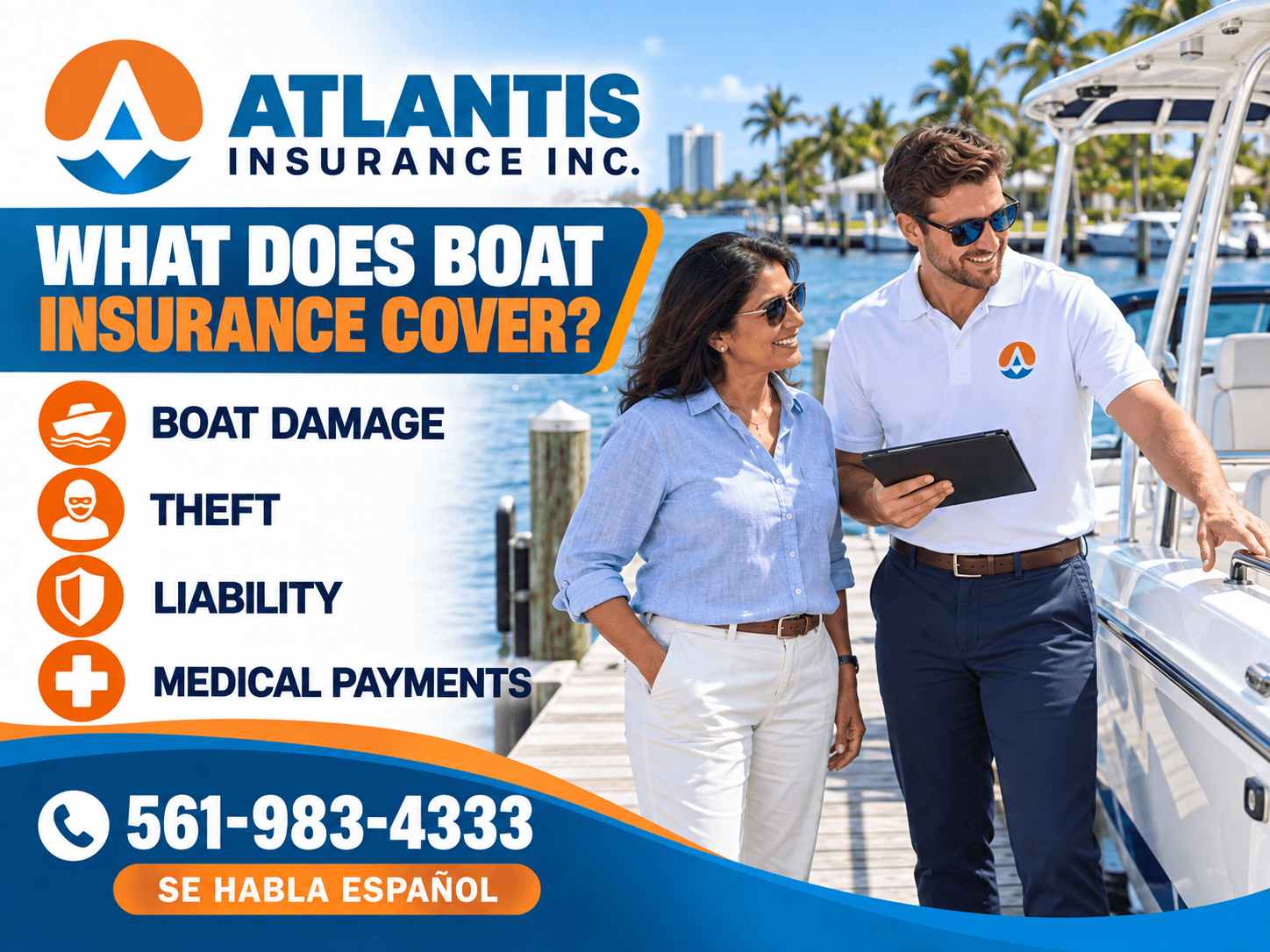
A boat policy answers four questions. Everything on the declarations page is one of them.
Coverage lists are hard to read because they are organized the way insurers think rather than the way owners worry. Sorted by the question being asked, a marine policy is much simpler than it looks.
Who fixes my boat. Who pays for what my boat did to someone else. Who gets my boat out of the water when something goes badly wrong. And who pays when the other boater has nothing. Those are the four, and knowing which coverage answers which is most of understanding the document.
Who fixes my boat
This is hull and physical damage coverage, and it is the part owners think of first.
It covers the vessel, her engines, machinery, and permanently attached equipment against collision, fire, theft, vandalism, lightning, sinking, grounding, and storm damage. On most marine policies it is written on an all-risk basis, meaning it responds to any cause not specifically excluded rather than to a list of named perils.
One consequence worth knowing, because it surprises people who have been through a home claim: this covers storm surge and flooding damage to the vessel. There is no separate flood policy for a boat, and no wind-versus-water argument, because a single form answers for both.
What decides whether this coverage is any good is not whether it appears on the quote. It is the insured value and the valuation method, which is covered in Agreed Value vs Actual Cash Value Boat Insurance.
Who pays for what my boat did
This is the liability section, and it is the coverage that can reach past the boat and into everything else you own.
It responds when you are legally responsible for injuring someone or damaging their property: a passenger hurt aboard, a swimmer struck, another vessel damaged, a dock or seawall taken out during a bad approach. It also pays defense costs, which matter more than owners expect, because fault in a crowded waterway is contested more often than not.
The number here is chosen once and rarely revisited, usually against the value of the boat rather than against the value of an injury claim. That is the wrong benchmark. A serious injury does not care what your vessel is worth, which is why this is the coverage most likely to be inadequate on an otherwise sensible policy, and why the layer above it matters. That is covered in Do Florida Boat Owners Need Umbrella Insurance?.
Medical payments sits alongside liability and pays limited medical expenses for people hurt aboard regardless of fault. It is a small limit meant to handle a minor injury quickly rather than to substitute for health coverage.
Who gets my boat out of the water
This group of coverages has no equivalent in auto or home insurance, and it is where marine policies earn their keep.
Towing and on-water assistance responds to the ordinary bad day: an engine that quits, a dead battery, running out of fuel. The limit matters more than the coverage, because a tow from twenty miles offshore is a different transaction from a tow inside the inlet.
Salvage responds when the vessel is in peril and must be recovered, which is a different and more expensive proposition than a tow. Wreck removal responds when the boat cannot be saved and an authority requires it be removed. Pollution and fuel spill liability covers the cleanup when fuel reaches the water.
Those three deserve a specific question rather than a nod: what are the limits, and do they sit inside the hull and liability limits or in addition to them. Salvage paid within the hull limit can consume the money meant to repair the boat.
Hurricane haul-out reimbursement belongs here too. It pays some of the cost of hauling or relocating the vessel when a storm is named, and it is not automatically included.
Who pays when the other boater has nothing
Florida does not require recreational boat owners to carry liability insurance, so the person who hits you may have nothing behind them.
Uninsured and underinsured boater coverage answers that, protecting you and your passengers when someone else causes the accident and cannot pay for it. It is not on every policy and it is inexpensive. In a state with this much traffic and no coverage mandate, leaving it off is hard to justify.
What is not on the boat policy at all
Three things get assumed onto a marine policy and are not there.
Your dock, lift, and seawall are property, not vessel, and they fall between the home policy and the flood policy in a way that leaves most waterfront owners uncovered. That is covered in Boat Insurance for Waterfront Homeowners in Florida.
Flood coverage for your house is a separate policy entirely. The boat being covered for surge says nothing about the home.
And a marine policy is not a warranty. Mechanical breakdown, wear, and corrosion are outside it by design, along with a longer list covered in What Boat Insurance Does Not Cover in Florida.
Every quote lists the same coverages
This is the part worth carrying away. Put two boat quotes side by side and the coverage names will match almost exactly. Physical damage, liability, medical payments, towing, salvage, pollution, uninsured boater. The list tells you nothing.
The differences are in the numbers and the conditions: the insured value and how it is settled, the liability limit, the deductibles including the named storm percentage, whether salvage and pollution share limits with something else, and what the policy requires of you when a storm is named or you leave your navigational territory.
That is what a real comparison looks like, and it is not something a quoting form will do for you.
Worth confirming on your current policy
-
The insured value, and whether it is agreed value throughout or on the hull only
-
The liability limit, measured against an injury claim rather than the boat’s value
-
Both deductibles, including the named storm deductible as a dollar figure
-
Whether salvage and wreck removal are included, and whether they sit inside the hull limit
-
Whether pollution liability is present and separate from the liability limit
-
Your towing limit, against the distance you actually run
-
Whether uninsured boater coverage is included
-
Whether hurricane haul-out reimbursement is on the policy
-
Your navigational territory and what the storm conditions require of you
Bring the whole policy, not the summary page
Atlantis Insurance is an independent agency in Stuart serving boat owners across the Treasure Coast, Palm Beach County, and Florida’s west coast. The coverage list on a quote is the least informative page in the document. The numbers and the conditions are where two policies actually differ.
Send us what you have and we will tell you which questions it really answers.
Atlantis Insurance Inc 850 NW Federal Highway, Suite 129 Stuart, FL 34994 561-983-4333