
Three different things make a boat claim fail. Only one of them is an exclusion.
Owners tend to use the word exclusion for everything that goes wrong at claim time. But the failures work differently, they are defended differently, and the one that surprises people most is not an exclusion at all.
The first category turns on what caused the loss. The second turns on what you did, regardless of cause. The third involves no denial whatsoever: the coverage applies and the money simply runs out. Knowing which one you are dealing with is most of understanding your policy.
One: exclusions, which turn on cause
Marine policies cover sudden and accidental loss. They do not cover the boat getting older.
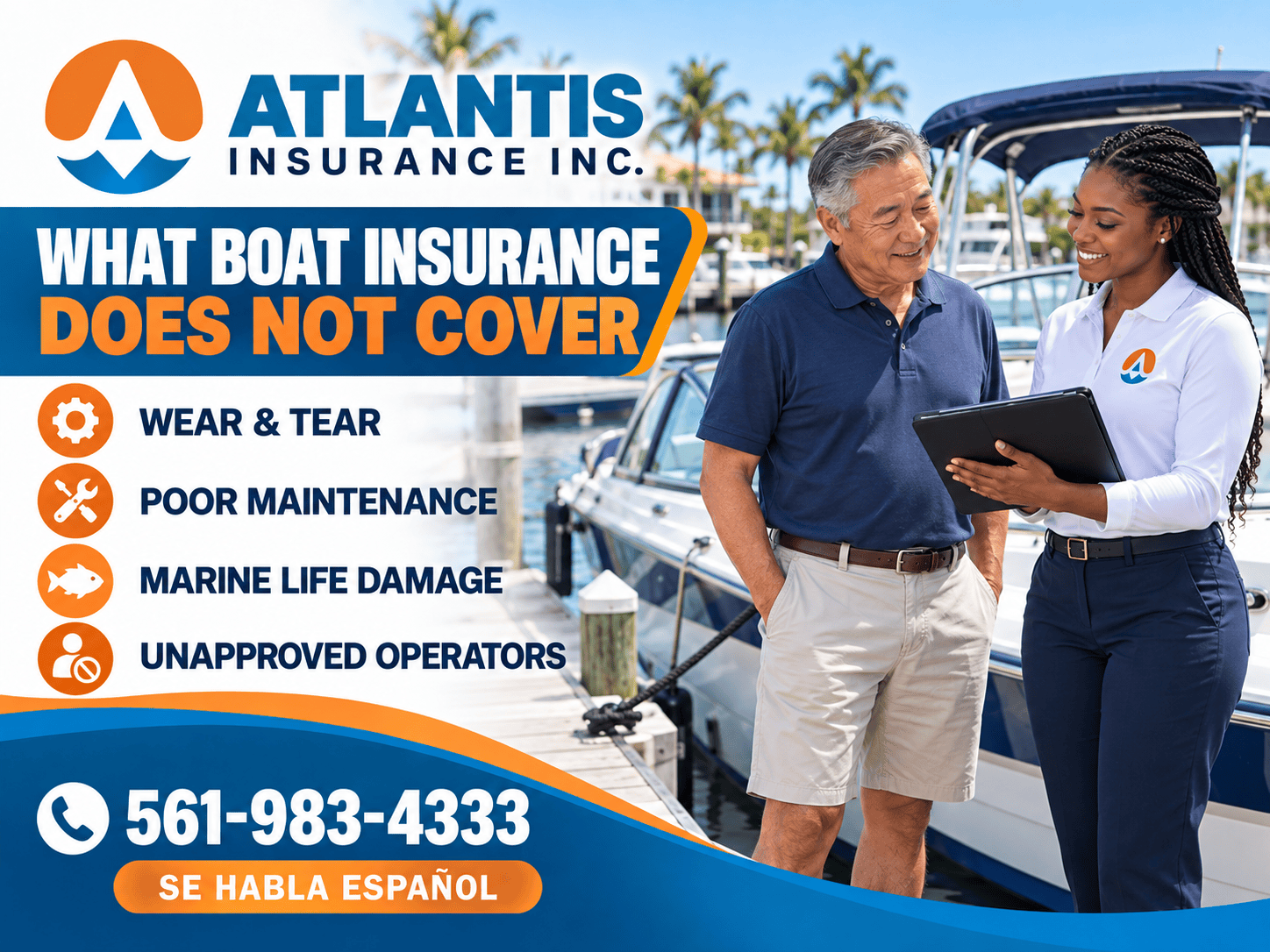
Wear and tear, corrosion, gradual deterioration, rot, delamination, mold and mildew from ordinary humidity, marine growth, and mechanical breakdown are all outside the coverage. In Florida this category does more work than anywhere else, because heat, salt, and humidity age a vessel faster than an owner notices.
The practical version: a hose clamp that had been weeping for a year, a through-hull that had been seeping, a pump that had been intermittent since spring. When the boat sinks, the question is not whether sinking is covered. It is whether the sinking was sudden or the arrival of something that had been happening slowly. That is the argument, and it is the one most large claims turn on.
The exception worth knowing: resulting damage
Exclusions of this kind usually apply to the failed part, not to everything downstream of it.
If a defective component causes damage to the rest of the vessel, many policies pay for that damage while declining to pay for the part itself. The Inchmaree clause, common on yacht forms, goes further and extends coverage to loss caused by latent defects and by the negligence of crew or repairers, again while excluding the cost of replacing the defective item.
Whether your policy contains that clause, and how broadly it is drawn, is one of the sharpest differences between two marine policies that look identical on the summary page. It is covered in more detail in Yacht Insurance in Florida.
Two: warranties, which turn on your conduct
This is the category owners never see coming, because it has nothing to do with what damaged the boat.
A warranty is a promise you made when the policy was written. Where the vessel will be kept. What you will do when a storm is named. Where you will and will not navigate. Who may operate the boat. Whether you will address the recommendations from the survey.
Break one of those and a claim that was squarely covered can fail anyway. The hurricane did the damage, the hurricane is a covered peril, and the policy still does not pay because the boat was supposed to be hauled and it was not. That is a different mechanism from an exclusion and there is no arguing about causation, because causation was never the issue.
The storm warranty is the one most likely to matter in Florida, and it is discussed in High-Value Boat Insurance in Florida.
Three: limits, which exclude nothing and still leave you paying
The third category is the quietest. Nothing is denied. The coverage responds exactly as written and stops.
Personal effects are covered at a sublimit that will not replace a serious tackle collection or a set of dive gear. Towing is covered at a limit set for a local breakdown rather than one twenty miles offshore. Salvage is covered, but inside the hull limit, so a substantial salvage award leaves less for the boat. Liability is covered at whatever number was chosen years ago against a vessel worth a fraction of what is tied up around you now.
None of that is an exclusion and none of it will be denied. An owner reading a policy for what is excluded will miss all of it, which is why the sublimits deserve as much attention as the exclusions section.
Valuation belongs in this category too. An actual cash value settlement is not a denial, and neither is depreciation applied to outboards and canvas under an agreed value policy. That is covered in Agreed Value vs Actual Cash Value Boat Insurance.
The uses that remove the policy’s foundation
A fourth situation is worth separating out because it is not a gap so much as a mismatch.
Personal boat policies are written for recreational use. Taking paid passengers, running charters or paid instruction, or listing the vessel on a boat-sharing platform is commercial activity, and a personal policy was not priced or underwritten for it. Racing and organized speed events are generally excluded as well unless specifically endorsed.
These are disclosable in advance and insurable through the right market. What does not work is discovering the mismatch after the loss.
What you can actually do about the causation argument
For the first category, documentation is the entire defense.
A current survey with its recommendations addressed and receipts to prove it. Maintenance records showing the boat was serviced rather than merely used. Photographs from before the season rather than after the loss. Receipts for repowering, electronics, and upgrades.
None of that changes the policy language. All of it changes the position you argue from when a carrier asks whether the failure was sudden or the end of a long decline. Owners who keep these files rarely need them and are glad they did.
For the second category, the answer is simpler: read the conditions section once, before the season, and know what you promised.
Worth confirming on your current policy
-
What the wear, deterioration, and mechanical breakdown exclusions actually say
-
Whether resulting damage is covered when a defective part causes it
-
Whether a latent defect or Inchmaree clause is present
-
Every warranty on the policy, including storage, storm, navigational, and operator conditions
-
Whether survey recommendations have been addressed and documented
-
Your sublimits for personal effects, fishing equipment, towing, and trailer
-
Whether salvage sits inside or above the hull limit
-
Whether the policy is agreed value throughout or on the hull only
-
That no part of how you use the boat has drifted into commercial territory
The exclusions page is not where the surprises live
Atlantis Insurance is an independent agency in Stuart serving boat owners across the Treasure Coast, Palm Beach County, and Florida’s west coast. Most owners who ask us what their policy excludes are actually asking a broader question, and the answer usually turns out to be a warranty they did not know about or a sublimit they never looked at.
Send us the policy and we will read all three parts of it.
Atlantis Insurance Inc 850 NW Federal Highway, Suite 129 Stuart, FL 34994 561-983-4333