

Hurricane Season Starts June 1: Boat Insurance Checklist for Florida Boat Owners
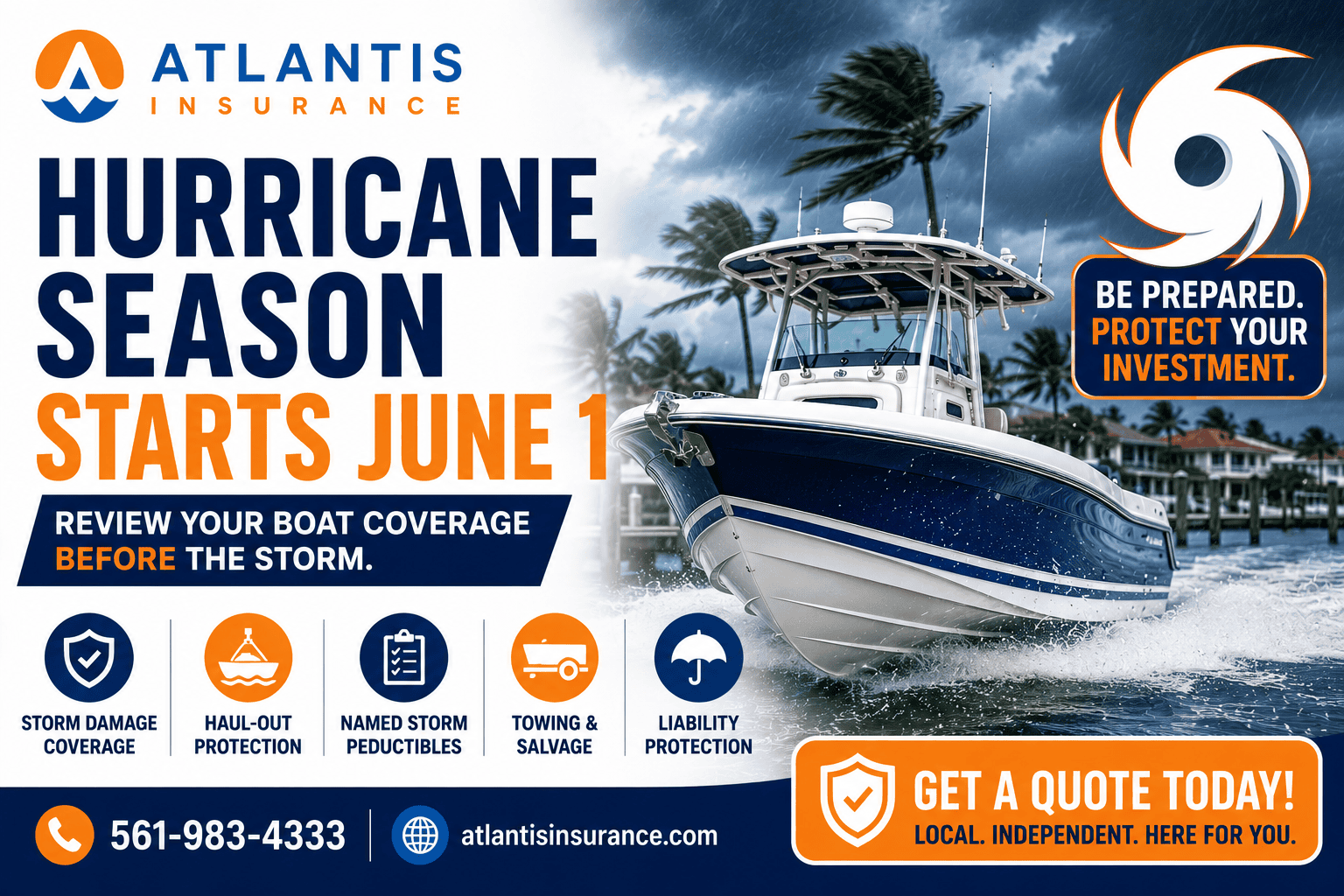
Hurricane season in the Atlantic officially begins June 1 and runs through November 30, according to the National Hurricane Center. For Florida boat owners, that date should be more than a calendar reminder. It should be the deadline to review your boat insurance, storm plan, storage location, hurricane deductible, haul-out options, and liability protection before a named storm is already on the way.
Many boat owners wait until a storm is approaching to think about insurance. By then, it may be too late to make important changes. Insurance companies may restrict new coverage, policy changes, or binding once a storm is active or approaching Florida.
That is why the best time to review your boat insurance is before hurricane season starts.
Atlantis Insurance Inc helps Florida boat owners review watercraft insurance options for boats, jet skis, personal watercraft, yachts, and other recreational vessels.
If you are looking for boat insurance in Florida, you can learn more about our main watercraft insurance page here:
https://www.atlantisinsurance.com/personal-insurance/watercraft-insurance/
Why June 1 Matters for Florida Boat Owners
June 1 is the official start of Atlantic hurricane season. While storms can sometimes develop before or after the official season, the June 1 date is a useful reminder for Florida boat owners to prepare early.
Boat owners should use this time to review:
Boat insurance coverage
Hull value
Liability limits
Named storm deductibles
Hurricane haul-out coverage
Storage location
Marina requirements
Trailer coverage
Towing coverage
Salvage coverage
Fuel spill liability
Umbrella insurance
Photos and documentation
Storm preparation plan
Waiting until a storm is named can create problems. Coverage changes may be limited, marinas may be full, haul-out services may be booked, and storage options may disappear quickly.
Do Not Wait Until a Storm Is Named
One of the biggest mistakes boat owners make is waiting until the forecast becomes serious.
By the time a storm is approaching Florida, you may not be able to:
Buy a new boat insurance policy
Increase coverage limits
Add physical damage coverage
Change valuation method
Lower deductibles
Add hurricane haul-out coverage
Add towing or salvage coverage
Change storage details
Add umbrella coverage
Get a marina haul-out appointment
Move the boat to preferred storage
Insurance is designed to be reviewed before the risk becomes immediate.
If you own a boat, jet ski, personal watercraft, or yacht, June 1 is the right time to confirm that your coverage is ready.
Confirm Your Boat Insurance Policy Is Active
Start with the basics.
Before hurricane season begins, confirm that your boat insurance policy is active and paid.
Check:
Policy effective dates
Renewal date
Payment status
Named insured
Boat information
Lienholder information, if financed
Storage location
Navigation territory
Coverage limits
Deductibles
If your policy has lapsed or is close to renewal, do not wait. A lapse during hurricane season can create serious problems.
Review the Insured Value of Your Boat
Your boat’s insured value should be accurate.
If your boat is underinsured, you may have problems after a major claim. If your boat has upgrades, newer engines, electronics, custom features, or expensive equipment, those details should be reviewed.
Review whether the policy reflects:
Hull value
Engines
Electronics
Navigation equipment
Trailer
Custom upgrades
Fishing equipment
Permanently attached equipment
Recent improvements
If you have receipts, photos, surveys, or documentation, keep them in a safe place.
Confirm Agreed Value vs Actual Cash Value
One of the most important boat insurance questions is how the boat will be valued after a covered total loss.
Two common valuation methods are agreed value and actual cash value.
Agreed value may provide more certainty because the insured value is agreed upon when the policy is written.
Actual cash value may factor in depreciation, which can reduce the claim payment after a loss.
This can make a major difference after a hurricane, theft, sinking, fire, or total loss.
Read more here:
Agreed Value vs Actual Cash Value Boat Insurance
https://www.atlantisinsurance.com/blog/agreed-value-vs-actual-cash-value-boat-insurance
Review Your Named Storm or Hurricane Deductible
Florida boat insurance policies may have special deductibles for named storms, hurricanes, or windstorm claims.
Do not assume your standard deductible applies to every loss.
Review:
Standard deductible
Named storm deductible
Hurricane deductible
Windstorm deductible
Percentage deductible
Minimum deductible amount
When the deductible applies
Whether it applies to partial losses
Whether it applies to total losses
A policy with a lower premium may come with a higher storm deductible. That can create a surprise after a claim.
Confirm Hurricane Haul-Out Coverage
Hurricane haul-out coverage may help reimburse the cost to move, haul, or secure the boat when a named storm is approaching.
This may include:
Hauling the boat out of the water
Moving the boat to a safer location
Dry storage
Professional marina assistance
Captain services
Storm preparation expenses
This coverage is not always automatically included. It may have limits, timing rules, reimbursement conditions, or specific requirements.
If your boat is kept at a marina, private dock, lift, or coastal storage location, hurricane haul-out coverage should be reviewed before hurricane season.
For a deeper explanation, read:
Boat Insurance for Hurricanes in Florida
https://www.atlantisinsurance.com/blog/boat-insurance-for-hurricanes-in-florida
Confirm the Storage Location on Your Policy
Your boat insurance policy may list where the boat is normally stored.
If that location has changed, tell your agent.
Storage locations may include:
Marina
Private dock
Boat lift
Dry storage
Garage
Trailer
Storage facility
Boatyard
In-water storage
Inland storage
Storage location matters because it affects theft risk, hurricane exposure, storm surge exposure, wind exposure, and underwriting.
If your policy says the boat is stored in one location but it is actually stored somewhere else, that could create problems after a claim.
Review Marina Requirements
If your boat is kept at a marina, review your marina contract before hurricane season.
The marina may require:
Proof of insurance
Certain liability limits
Specific storage rules
Storm preparation steps
Haul-out deadlines
Removal of canvas or loose items
Additional insured wording
Compliance with dock master instructions
Marina requirements are not the same as full insurance protection. A marina may require a minimum liability limit, but that does not mean the limit is enough to protect your assets.
Check Trailer Coverage
If your boat has a trailer, make sure the trailer is properly listed or covered.
Review:
Is the trailer included?
What is the trailer value?
Is theft covered?
Is collision covered?
Is damage while parked covered?
Is damage while towing covered?
Does your auto policy apply while towing?
Is the boat covered while being transported?
Trailer coverage can be important if you plan to move the boat before a storm.
Review Towing Coverage
Boat towing can be expensive, especially if your boat breaks down offshore, near an inlet, or far from your home marina.
Before hurricane season, review whether your policy includes towing and emergency assistance.
Towing coverage may help with:
On-water towing
Fuel delivery
Jump starts
Emergency assistance
Transport to a marina
Basic breakdown response
Low towing limits may not be enough for Florida boaters who travel offshore or use their boats frequently.
Review Salvage and Wreck Removal Coverage
After a hurricane, a boat may need to be recovered, raised, removed, transported, or salvaged.
Salvage and wreck removal can be expensive.
Review whether your policy includes:
Salvage coverage
Wreck removal
Recovery expenses
Emergency response costs
Pollution cleanup
Whether salvage is included in the hull limit
Whether salvage is in addition to the hull limit
A weak salvage provision can create a major out-of-pocket cost after a storm.
Review Fuel Spill Liability
If a boat sinks, breaks loose, catches fire, or leaks fuel during a storm, cleanup costs can become expensive.
Fuel spill liability may help cover cleanup costs if your boat causes pollution after a covered loss.
Review whether fuel spill liability is included and what limit applies.
This is especially important for boats kept at marinas, docks, canals, rivers, bays, and coastal areas.
Take Updated Photos Before Hurricane Season
Photos can help document the condition of your boat before a storm.
Before hurricane season, take clear photos of:
Exterior
Interior
Engines
Electronics
Hull
Trailer
Storage location
Dock lines
Lift setup
Safety equipment
Custom upgrades
Fishing equipment
Serial numbers, when available
Store the photos somewhere you can access even if your phone, computer, or home is damaged.
Save Receipts and Upgrade Records
If you have upgraded your boat, keep records.
Save receipts for:
Engines
Electronics
Navigation equipment
Audio systems
Canvas
Towers
Fishing equipment
Safety equipment
Trailer upgrades
Repairs
Maintenance
Custom work
These records may help support the insured value and claim review after a loss.
Confirm Navigation Territory
Boat insurance policies often include a navigation territory.
If you operate outside that territory, coverage may be limited or unavailable.
Before hurricane season, review whether your policy covers:
Florida waters
Coastal waters
Inland waters
Offshore use
Bahamas trips
Extended cruising areas
Temporary relocation before a storm
If you plan to move the boat outside its normal area, confirm coverage first.
Review Jet Ski and Personal Watercraft Coverage
Jet skis and personal watercraft also need hurricane preparation.
If you own a jet ski, confirm:
Physical damage coverage
Liability coverage
Trailer coverage
Storage location
Theft coverage
Storm coverage
Towing coverage
Operator rules
Whether it is listed on your umbrella policy
Read more here:
Jet Ski Insurance in Florida
https://www.atlantisinsurance.com/blog/jet-ski-insurance-in-florida
Review Yacht Insurance Early
Yachts and higher-value vessels often need more detailed hurricane planning.
A yacht policy may include requirements involving:
Written hurricane plans
Approved marinas
Captain services
Crew responsibilities
Navigation territory
Haul-out procedures
Survey requirements
Higher deductibles
Storm season restrictions
If you own a larger or higher-value vessel, review yacht insurance here:
https://www.atlantisinsurance.com/personal-insurance/yacht-insurance/
If your yacht is part of a larger personal insurance portfolio, review high net worth insurance here:
https://www.atlantisinsurance.com/personal-insurance/high-net-worth-insurance/
Review Umbrella Insurance
Boat liability claims can be expensive.
If your boat injures someone, damages another vessel, damages a dock, or creates a lawsuit, your boat liability limits may not be enough.
Personal umbrella insurance may provide an extra layer of liability protection above eligible underlying policies, including home, auto, condo, and boat insurance.
However, umbrella policies may require the boat to be listed, properly insured, and carry certain underlying liability limits.
Review umbrella insurance here:
https://www.atlantisinsurance.com/personal-insurance/umbrella-insurance/
Read more here:
Do Florida Boat Owners Need Umbrella Insurance?
https://www.atlantisinsurance.com/blog/do-florida-boat-owners-need-umbrella-insurance
Review Home, Condo, and Flood Insurance Too
Boat owners often own waterfront homes, condos, seasonal residences, or coastal property.
Hurricane season is a good time to review your full personal insurance plan, not just the boat.
Review:
Homeowners Insurance
https://www.atlantisinsurance.com/personal-insurance/home-insurance/
Condo Insurance
https://www.atlantisinsurance.com/personal-insurance/condo-insurance/
Flood Insurance
https://www.atlantisinsurance.com/personal-insurance/flood-insurance/
Watercraft Insurance
https://www.atlantisinsurance.com/personal-insurance/watercraft-insurance/
Umbrella Insurance
https://www.atlantisinsurance.com/personal-insurance/umbrella-insurance/
Flood insurance is especially important because standard homeowners insurance usually does not cover flood damage.
Create a Written Hurricane Plan
A written hurricane plan can help you act faster when a storm approaches.
Your plan should include:
Where the boat will go
Who will move it
Who has access to keys
Marina contact information
Haul-out provider
Trailer availability
Storage location
Insurance carrier contact
Agent contact
Photos and documents
Emergency supplies
Storm preparation checklist
Deadlines for action
Do not rely on memory during a storm. A written plan makes it easier to act quickly.
Questions to Ask Your Agent Before June 1
Before hurricane season starts, ask:
Is my boat policy active?
Is my hull value accurate?
Is my policy agreed value or actual cash value?
What is my named storm deductible?
Do I have hurricane haul-out coverage?
Is my storage location correct?
Is my trailer covered?
Do I have towing coverage?
Do I have salvage coverage?
Do I have fuel spill liability?
Is my navigation territory correct?
Are jet skis or personal watercraft covered?
Does my umbrella policy include the boat?
Do I meet all underlying liability requirements?
Are there storm preparation conditions?
Are there marina requirements I should know about?
These questions can help identify gaps before a storm is active.
Why Work With Atlantis Insurance Inc?
Atlantis Insurance Inc is an independent insurance agency serving Florida clients from our Stuart office.
We help Florida boat owners review watercraft insurance before hurricane season so coverage gaps are easier to identify before a claim happens.
Working with Atlantis Insurance Inc gives you access to:
Independent coverage options
Florida insurance experience
Help with boats, jet skis, and yachts
Review of hurricane and storm exposures
Guidance on liability limits
Options for umbrella insurance
Help identifying policy gaps
Local service and support
Boat insurance in Florida should be reviewed before June 1, not after a storm is already approaching.
Get a Boat Insurance Review Before Hurricane Season
If you own a boat, jet ski, personal watercraft, or yacht in Florida, Atlantis Insurance Inc can help you review your coverage before hurricane season.
We can help you compare coverage for physical damage, liability, named storm deductibles, hurricane haul-out, towing, salvage, fuel spill liability, uninsured boaters, umbrella insurance, and more.
Learn more about watercraft insurance here:
https://www.atlantisinsurance.com/personal-insurance/watercraft-insurance/
Call Atlantis Insurance Inc today at 561-983-4333 or request a quote online.
Related Articles
Boat & Watercraft Insurance in Florida
https://www.atlantisinsurance.com/personal-insurance/watercraft-insurance/
Boat Insurance for Hurricanes in Florida
https://www.atlantisinsurance.com/blog/boat-insurance-for-hurricanes-in-florida
How Much Does Boat Insurance Cost in Florida?
https://www.atlantisinsurance.com/blog/how-much-does-boat-insurance-cost-in-florida
What Does Boat Insurance Cover in Florida?
https://www.atlantisinsurance.com/blog/what-does-boat-insurance-cover-in-florida
What Boat Insurance Does NOT Cover in Florida
https://www.atlantisinsurance.com/blog/what-boat-insurance-does-not-cover-in-florida
Jet Ski Insurance in Florida
https://www.atlantisinsurance.com/blog/jet-ski-insurance-in-florida
Agreed Value vs Actual Cash Value Boat Insurance
https://www.atlantisinsurance.com/blog/agreed-value-vs-actual-cash-value-boat-insurance
Do Florida Boat Owners Need Umbrella Insurance?
https://www.atlantisinsurance.com/blog/do-florida-boat-owners-need-umbrella-insurance
Yacht Insurance in Florida
https://www.atlantisinsurance.com/blog/yacht-insurance-in-florida